7/2
Started my tour today in an old non air-conditioned gray Soviet van that we named Igor. Long drive through basic flatlands. We did see a few giant hawks, some heron-type things (cranes) and horses, goats, sheep, cows and dogs. Mongolia has 18 times the number of farm-type animals as it does people.
Igor held eight people; Ekra, the driver, Selonga, the "guide"/cook, and six tourists; Jenny, a Korean girl, Vicky and Craig, British Doctors, Bert and Giselle, an old German couple, and myself. At around four, we stopped at Baga gazariin chuluu, a temple that was destroyed by the Soviets in the 1930s. It was decent, with pretty scenery, and blessedly, only one other group of tourists- even smaller than ours, and a Mongolian father and son were there.
While waiting for Selonga to make dinner, I went for a nice walk around the rocks, then went back to our ger. A ger (known in the West as a yurt) is the traditional Mongolian home. It's a short, round wooden structure, padded by a thick layer of wool and covered in canvas. Usually, there is a shrine on the far wall facing you as you enter the door, though you'd trip over the stove, which is kept in the middle of the room so the chimney can exit through the circular hole on top that is generally half-covered. The beds, or more typically, mattresses, are pressed against the walls as if from centrifugal force. The toilet is an outhouse outside, though sometimes it's just a hole in the ground, covered with a few wooden slats to stand on while you squat.
7/3
Today was another long day of driving (350 km), though at least my lunch was excellent today (though not markedly different- more meat, vegetables and potatoes all fried together, served with rice). We saw our first group of camels and drove to Temeen shavar (the Flaming Cliffs), which were very nice, but (and I feel a bit bad saying this), I'm starting to think I could've done an off-road trip from part of California through the Southwest and had essentially the same experience. Trade gers for a few scattered houses or cabins and temples for churches and that's pretty much it. Both have blue skies and vast emptiness, people herding animals, and not a whole ton in the way of culture.
I think I can go one more day without a shower before I start to feel really gross. I'll likely have a babywipes bath tonight. Apparently much of the area we've been passing through on our way to the desert is known as the Steppes (pronounced steps) and is basically just endless flat, slightly green plains.
After I'd written all this, at about 10:30 p.m., my germates and I noticed a lot of noise coming from our next-door neighbors. Jenny came by and told us they were watching the world cup inside. Vicky and I had remarked on the satellite dish upon arriving at this ger camp, which was an odd enough sight in such a remote site, but to actually see a small newish looking but black and white t.v. playing the Germany-Argentina World Cup game inside a ger in the middle of complete nothingness in Mongolia was surreal. The bright white light illuminated the almost exclusively white faces inside, the Mongolians who actually lived in that ger (save two sitting in the very front), had abdicated their seats for the foreigners and so a Mongolian grandmother, mother, two men and a child sat watching through the door and refused stools when one of the foreigners offered to give up theirs.
It was a bizarre experience, all the more so because I was watching part of the World Cup without beer. We later agreed that they should have charged admission and had beer available for sale and they would've made more money than they did selling the handmade woolen items (toy gers, camels, hats, purses). It was also amazing to think that the World Cup actually reached that far and made me feel more inclined to watch it and helped me understand its relevance was real- I'd always assumed that the idea of rural people in poor countries watching the WC and the world feeling united was pure propaganda, but seeing it actually bring together people of different cultures and places was almost...well, let's not go that far- it's still soccer.
7/4
Even though this post won't actually go up until later, I still feel obligated to write a patriotic post in honor of Independence day, especially since I won't get fireworks, sparklers, a beach or a barbeque, though I might get beer.
Things the U.S. Does/Has Better Than Anywhere Else:
Movies/ Movie Theater Experience
Customer Service
Individual Rights
Road Trips
Directness
Medical Care (IF you can afford it)
Better Than Most:
Cheese
Ice Cream
Mexican Food
Quality of Higher Education (ignoring all the many problems with it)
When, that is, if, you think of Mongolia, you probably think, as I did, of vast deserts (meaning the Gobi) and little else. Today, in the Yol Valley of the South, I saw an Ice river/ glacier. We'd driven a few hours this morning to get there and arrived at the museum near the entrance around noon. The museum was just a few smalls rooms, all except one filled with indigenous stuffed animals. The other room had four glass cases and a table in it. Two cases contained small dinosaur bones and remnants. One contained a partially exposed small dinosaur skeleton, remarkably preserved in a way so that you could see its basic shape still. The last glass case contained several dinosaur eggs, some almost whole, some broken into a few (though not many) pieces. Most interesting to me, however, was the table. On a basic, small rectangular card table, without any covering whatsoever, were dinosaur bones. The sign didn't say what kind, but there they were, just sitting on the table like sewing machines at a garage sale, waiting for someone to pick up and ask "How much for this one?" The sign did say not to touch them, but I'm a rebel, so I stroked one giant dirtied-ivory colored bone, thicker than two soda cans. The part I touched was fairly solid, but most parts looked splintered, like wood while it's burning. I did learn one thing in the museum however: Mongolia has snow leopards, though they're very, very, very rare (according to Vicky who said she watched a documentary on it, it took the BBC team three weeks to spot one and that was using the latest technology with several people, filming 24 hours a day).
Igor has not been happy with us and our poor comrade has overheated often, forcing us to get out, pour water into his engine (which is inside the car in the front seat between the driver and shotgunner, under a leather covered compartment), wait around for a while, and try again. He made it to the parking lot for the walk out to the glacier and we had lunch Selonga had prepared that morning (over-oiled fried rice with a tiny bit of mutton inside and carrots). It was only a 2 km walk to the ice and it was a very nice mostly-flat walk by a stream that became a river, through green grass that climbed onto hills that turned into small rocky mountains. Most of it reminded me of the Seven Sisters near San Luis Obispo. The ice river was rather random and seemed to just come out of nowhere so that was cool. I slid along it a bit and watched it melt away, drip by drip. It'll be gone by the time I put this post up. It was pretty but mostly just impressive because it was so surprising and random, just there. A big chunk of ice in the Gobi Desert.
While we were gone our guide Erka had taken part of Igor's engine apart in an attempt to fix it and we had to wait for about an hour and a half after we got back for him to put it back together, and it only seemed to work marginally better.
Since we were so far behind schedule, we decided to stay nearby for the night. It was a fantastic decision as the place we found was a lovely, tiny village with a population of 50 or so. It was the sort of country, self-sufficient area Mao probably had wet dreams about. One interesting thing was that this tiny place had a basketball court and a basic elliptical with some other basic exercise equipment. In Northern Asia, I've noticed that in general, they seem to pay much more attention to their youth and old. For the young, there are many more options for things to do at night and on weekends like; video arcades (ubiquitous and larger and more extensive than in the U.S.), jimjillbangs and manga libraries/ internet cafes (again, better than those we have in the West). For the geriatric set, I've particularly noticed that several of the parks that have areas and exercise equipment specifically set off for Seniors (I know this because they have English signs) to keep them active and encourage physical and mental activity until they die.
Anyway, it was a lovely little area. After dinner and a walk around, I saw a group of men leaving the largest house (likely a school/ community center) who were dressed in red and blue briefs. They got into cars and drove off. Soon afterwards I left too and walked back to our ger camp.
As I walked over the hill, I could see that the cars had stopped just in front of our group of five gers and that all the tourists were sitting in about a third of a circle and the men in briefs were inside the part of the circle they'd created.
My guide said they were going to do a show for us, and that it was 4,000 per person (about $3) to watch. It looked interesting, so I said I would and sat down. They'd already started a bit but when they started a new round, the two men would stand from about fifty feet back, then slapped the front of their thighs twice, then slapped their butts then slowly jogged over to their referee (there were always at least two). Just before reaching their designated referee, they'd start to do this very slow movement of flapping their arms up and down, in a way that was supposed to represent a hawk. I imagine it was supposed to seem elegant and smooth, but it just managed to look idiotic. They'd "swoop" around their referee three times and then the referee would pat them on the shoulder and they'd go to dance circles with the other fighter. At some point, they'd embrace and be locked in a hug for ages until one finally made some movement that knocked the other off balance. You lost when your hands, knees or elbows touched the ground. It wasn't very active and most of the time the wrestlers weren't really moving, which is why they had two or three fights all going on at the same time. It seemed to be a bit of a psychological game in a way, but it also seemed that the men who looked the worst in their briefs, chubby bellies overhanging them, did the best. It was really neat to watch, and I got a picture with them afterwards, though not a very good one. Two of the tourist guys tried a match and one of them, who said he'd had some karate training, did okay. The other one was flat on his back in about ten seconds.
Showing posts with label Animals. Show all posts
Sunday, August 8, 2010
Sunday, May 16, 2010
Pinwheels, Spinning in the Wind
4/27
Aomori doesn't have a lot to see and I'd already seen most of the things I was interested in last night so I slept in and took my time getting up and ready. I made an obligatory stop at their fish market (which I could smell- yay, except...ewww) and got some takeaway. I was eating it in a large plaza and kicking at pigeons simultaneous when I saw the largest crow I've ever seen. It was probably three times the size of a normal crow and was really intimidating. I felt like I could finally understand why Tippi Hendran would be afraid of them in "The Crows" as I made a plan for what to do if it attacked me (kick, mostly, and whack with my purse).
Since I still had lots of time, I shopped around a bit, walked a bit farther and got a cup of Haagen-Daaz cookies and cream ice cream (I was PMSing, or at least, used that as my excuse). Finally it was time to get on the bus to see the one thing I particularly wanted to see in, well, outside of, Aomori; Seiryu-ji.
Showa Daibutsu is the largest outdoor Buddha in Japan. The complex it's in, Seiryu-ji, also includes numerous statues and a temple and five storied pagoda (the tallest one North of Kyoto). Amazingly, they had a very detailed brochure (4 pages of explanation on computer paper stapled together) in English! Usually this would be nice, but full of basic, vaguely interesting information that you'd forget in an instant but this brochure had a diatribe discussing the problem of secularism, a decline in ethics and insincere Buddhist priests! It was funny, bizarre, unexpected and fascinating. Western Honshu is seen by many Japanese in the same way that many Americans see the deep south: as a deeply religious, outdated place full of agriculture and bigotry and lacking education and pretentiousness. This rant made me understand this stereotype a bit better and amused me because if I replaced just a few of the words and removed a sentence of two I could easily imagine a middle aged white woman saying it in a Southern accent. Below, I've typed the best part, using parentheses to show words I would replace to make it work.
"There is another big reason for building the Daibutsu. (church.) After World War II in Japan, (the United States,) religion was excluded from the education curriculum due to separation of state and religion. Is moraland emotional education capable without religion? The answer is obvious when we look at the current situation. We have witnessed a decline in ethics. Such miserable cases as parents who have killed their children and children who have killed their parents and indiscriminate murders have often been reported. In contrast to the poverty-stricken society after WWII, (during the Great Depression,) we now enjoy the benefits of a developed economy, high quality education and scientific culture, which enable us to lead a very convenient life. However, there has been a growing concern that moral degenerations is progressing year by year. Although our economy, education and culture have developed, if we don't cultivate richness of the mind, Japan (the United States) will be in ruins someday. Then, who takes care of the issue of the mind? Religious people do. However, many Japanese Buddhist priests (American Preachers) behave as if priests' mission were only to perform rituals like funerals and memorial services."
Weird, right?
The temple was nice, as was the pagoda, but the real reason I came was to see Jizo Bosatsu (Boddhisattva) and put a pinwheel on this hill. The pinwheels are left by parents for their children who have died. Since my mother couldn't be there, I bought a green one and left it as high as I could get on that hill to catch the breeze for Joseph.
I walked up to the Giant Buddha and inside the hall underneath where you could see part of the structure. There was one group of Japanese tourists who came through while I was there but for the most part I had the place to myself.
Walking away from Buddha, I ran into Ichigan Kannon, who grants you just one wish.
Then I passed this fearsome god, Fudo Myooh, who is actually supposed to be good because he slays your negative thoughts with his sword and lassos people back onto the path of righteousness.
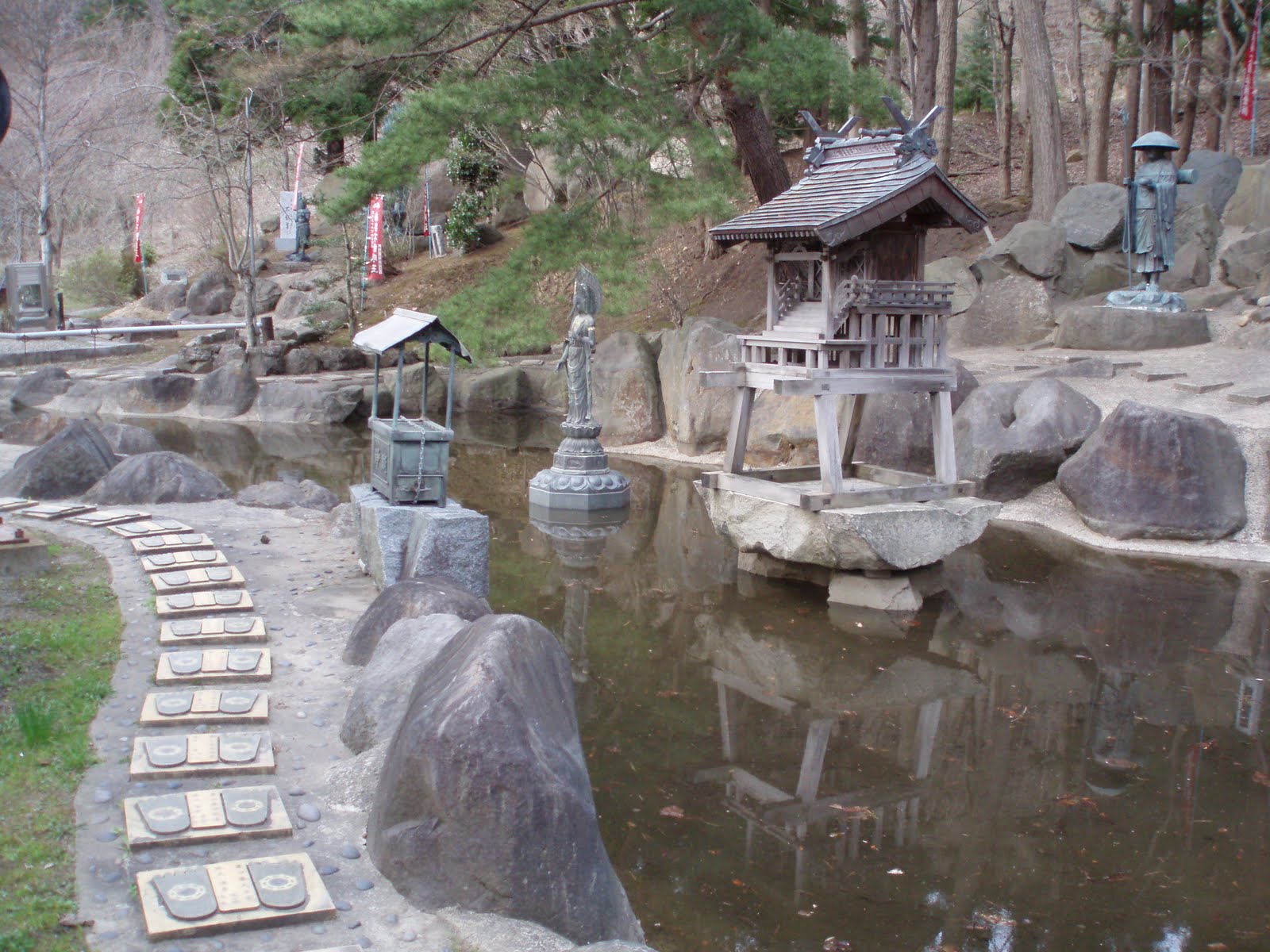
Kobo-Daishi is the statue on the other side of this pond and the founder of the Shingon sect of Buddhism. Each of the plates around the pond holds sand from one of the 88 temples associated with the Shingon sect. According to my brochure, it would be "a great experience to follow the footsteps of Daishi by stepping on the plates one by one, chanting his honorific name (Nama Daishi Henjokongo)." I tried it and it was just okay, not great.
This part, outside the main complex, is Kobo-Daishi-do, and these are the cool things that were inside it.
My overnight train to Sapporo (included in my rail pass so I didn't have to pay extra or for a hostel one night!) didn't leave until 10 p.m. but since I had nothing to do, from 8 onwards, after going online at the free internet place and getting dinner: a small crab and cheese omelette that was awesome and remarkably cheap and fantastic calamari, I just sat in the train station and finished reading The Lady and the Unicorn. On the train, I brushed my teeth and curled up with my mini tempurpedic pillow, my microfiber towel as a blanket, and an Ambien, and shortly, I was out.
Buddha's Head, Watching You Over the Treetops
Aomori doesn't have a lot to see and I'd already seen most of the things I was interested in last night so I slept in and took my time getting up and ready. I made an obligatory stop at their fish market (which I could smell- yay, except...ewww) and got some takeaway. I was eating it in a large plaza and kicking at pigeons simultaneous when I saw the largest crow I've ever seen. It was probably three times the size of a normal crow and was really intimidating. I felt like I could finally understand why Tippi Hendran would be afraid of them in "The Crows" as I made a plan for what to do if it attacked me (kick, mostly, and whack with my purse).
Since I still had lots of time, I shopped around a bit, walked a bit farther and got a cup of Haagen-Daaz cookies and cream ice cream (I was PMSing, or at least, used that as my excuse). Finally it was time to get on the bus to see the one thing I particularly wanted to see in, well, outside of, Aomori; Seiryu-ji.
Showa Daibutsu is the largest outdoor Buddha in Japan. The complex it's in, Seiryu-ji, also includes numerous statues and a temple and five storied pagoda (the tallest one North of Kyoto). Amazingly, they had a very detailed brochure (4 pages of explanation on computer paper stapled together) in English! Usually this would be nice, but full of basic, vaguely interesting information that you'd forget in an instant but this brochure had a diatribe discussing the problem of secularism, a decline in ethics and insincere Buddhist priests! It was funny, bizarre, unexpected and fascinating. Western Honshu is seen by many Japanese in the same way that many Americans see the deep south: as a deeply religious, outdated place full of agriculture and bigotry and lacking education and pretentiousness. This rant made me understand this stereotype a bit better and amused me because if I replaced just a few of the words and removed a sentence of two I could easily imagine a middle aged white woman saying it in a Southern accent. Below, I've typed the best part, using parentheses to show words I would replace to make it work.
"There is another big reason for building the Daibutsu. (church.) After World War II in Japan, (the United States,) religion was excluded from the education curriculum due to separation of state and religion. Is moraland emotional education capable without religion? The answer is obvious when we look at the current situation. We have witnessed a decline in ethics. Such miserable cases as parents who have killed their children and children who have killed their parents and indiscriminate murders have often been reported. In contrast to the poverty-stricken society after WWII, (during the Great Depression,) we now enjoy the benefits of a developed economy, high quality education and scientific culture, which enable us to lead a very convenient life. However, there has been a growing concern that moral degenerations is progressing year by year. Although our economy, education and culture have developed, if we don't cultivate richness of the mind, Japan (the United States) will be in ruins someday. Then, who takes care of the issue of the mind? Religious people do. However, many Japanese Buddhist priests (American Preachers) behave as if priests' mission were only to perform rituals like funerals and memorial services."
Weird, right?
The temple was nice, as was the pagoda, but the real reason I came was to see Jizo Bosatsu (Boddhisattva) and put a pinwheel on this hill. The pinwheels are left by parents for their children who have died. Since my mother couldn't be there, I bought a green one and left it as high as I could get on that hill to catch the breeze for Joseph.
I walked up to the Giant Buddha and inside the hall underneath where you could see part of the structure. There was one group of Japanese tourists who came through while I was there but for the most part I had the place to myself.
Walking away from Buddha, I ran into Ichigan Kannon, who grants you just one wish.
Then I passed this fearsome god, Fudo Myooh, who is actually supposed to be good because he slays your negative thoughts with his sword and lassos people back onto the path of righteousness.
Kobo-Daishi is the statue on the other side of this pond and the founder of the Shingon sect of Buddhism. Each of the plates around the pond holds sand from one of the 88 temples associated with the Shingon sect. According to my brochure, it would be "a great experience to follow the footsteps of Daishi by stepping on the plates one by one, chanting his honorific name (Nama Daishi Henjokongo)." I tried it and it was just okay, not great.
This part, outside the main complex, is Kobo-Daishi-do, and these are the cool things that were inside it.
My overnight train to Sapporo (included in my rail pass so I didn't have to pay extra or for a hostel one night!) didn't leave until 10 p.m. but since I had nothing to do, from 8 onwards, after going online at the free internet place and getting dinner: a small crab and cheese omelette that was awesome and remarkably cheap and fantastic calamari, I just sat in the train station and finished reading The Lady and the Unicorn. On the train, I brushed my teeth and curled up with my mini tempurpedic pillow, my microfiber towel as a blanket, and an Ambien, and shortly, I was out.
Tuesday, May 11, 2010
GEISHA! GEISHA! GEISHA!
4/23
While it wasn't exactly a gorgeous day out, it at least wasn't raining today, so I hopped on a train to Nara, a village close to Kyoto that was the first capital of Japan and thus has several lovely old sights. I think it's possible that the reason these sights survived the war was because they were located in such a small town that it didn't seem worth bombing, but that's pure conjecture.
Nara is what I call an ooh-ahh-out place. Awesome, incredible and absolutely worth your time, but only as a daytrip as can be seen in a few hours, maximum. One of the best examples of ooh-ahh-outs is Pisa, if that helps give you a better idea of what I'm talking about.
First was Kofuku-ji, a fairly large temple complex area, with three and five storied pagodas.
Then through the Nandaimon Gate, guarded by two giant statues, even though they look like paintings behind the nets:
All the people you see in yellow hats are Japanese schoolchildren, here on field trips. A group of them from Osaka, in elementary school and brown hats, came up to me for help on a project and asked me my name, where I was from, if I'd seen Todai-ji and what I thought the most surprising thing about Japan was. They were cute but didn't seem overly excited at my response to the last question: the cold.
To the largest wooden building in the world, Todai-ji:
Which contains a giant gold/bronze alloy Buddha:
It also has a supporting beam with a hole in it the size of one of Buddha's nostrils that people try to crawl through for good luck:
Deer Warnings:
For my last stop in Nara, I'd planned on going to the Isuien Garden but it cost something like $6 but, if you knew about it, you could go to a teahouse next door that overlooked it, from which point you could see everything and just buy something there. I got the cheapest thing on the menu; Japanese tea (matcha green tea) and dry candies. The tea was horrible- shockingly bitter, and the candies, as far as I could tell, were just balls of powdered sugar, so were too sweet, but the view was lovely, even if these idiots are blocking part of it in my picture:
I got back to Kyoto and still had lots of energy so I decided that since it was a Friday afternoon, it would be a good time to go geisha hunting in Gion, the traditional geisha part of Kyoto, which is especially famous for its geisha.
It was a great area and I really enjoyed walking around it and seeing all the narrow streets and alleyways and old buildings (or, more likely, old-looking ones) but after about two hours, I still hadn't seen any geisha in full costume, so I gave up in defeat and ran after these girls to get a picture, hoping they were maiko, apprentice geisha. It's highly unlikely that they were, and were probably just wearing kimonos because they'd been to a special temple or something that day. Kimono are worn here traditionally and/or ceremonially, so when you see older women wearing kimono, it doesn't necessarily mean anything except that that's what they're comfortable in, but when you see young women wearing one, it's a bit more meaningful and means they might have visited a temple or sacred sight that day. Also, the pink kimono was the prettiest one I saw in all my time in Japan.
Defeated, I still continued to walk around a bit, just wandering, looking more at the architecture and enjoying the lack of rain (though it was still a bit cold), when suddenly, out of a random doorway, a geisha appeared.
I don't think I can explain to you how excited I was; it was like seeing a unicorn. It made me wildly happy and I had to try to contain my giddiness as I asked her for a picture. She obliged, and I continued walking, fully satisfied.
Suddenly, again appearing out of nowhere, another geisha, looking almost identical to the previous one, came rushing out of a doorway. I caught her as she rushed away, and then got her to stop for a moment for a picture on her slower way back.
I couldn't believe it- I'd spent almost two hours looking for geisha without success and then had seen two in three minutes! About two minutes later, a third geisha ran by me. Three geisha in five minutes. I was floating on air.
For dinner, I found a cheap Japanese fast-food/diner style place where I got a large bowl of rice topped with sauteed onions and very thin and relatively fatty strips of beef, accompanied by a small bowl of soup and cold tea for about $4-5. It was really good, and the onion/beef mixture reminded me of French cooking flavors in a favorable way.
While it wasn't exactly a gorgeous day out, it at least wasn't raining today, so I hopped on a train to Nara, a village close to Kyoto that was the first capital of Japan and thus has several lovely old sights. I think it's possible that the reason these sights survived the war was because they were located in such a small town that it didn't seem worth bombing, but that's pure conjecture.
Nara is what I call an ooh-ahh-out place. Awesome, incredible and absolutely worth your time, but only as a daytrip as can be seen in a few hours, maximum. One of the best examples of ooh-ahh-outs is Pisa, if that helps give you a better idea of what I'm talking about.
First was Kofuku-ji, a fairly large temple complex area, with three and five storied pagodas.
Then through the Nandaimon Gate, guarded by two giant statues, even though they look like paintings behind the nets:
All the people you see in yellow hats are Japanese schoolchildren, here on field trips. A group of them from Osaka, in elementary school and brown hats, came up to me for help on a project and asked me my name, where I was from, if I'd seen Todai-ji and what I thought the most surprising thing about Japan was. They were cute but didn't seem overly excited at my response to the last question: the cold.
To the largest wooden building in the world, Todai-ji:
Which contains a giant gold/bronze alloy Buddha:
It also has a supporting beam with a hole in it the size of one of Buddha's nostrils that people try to crawl through for good luck:
Deer Warnings:
For my last stop in Nara, I'd planned on going to the Isuien Garden but it cost something like $6 but, if you knew about it, you could go to a teahouse next door that overlooked it, from which point you could see everything and just buy something there. I got the cheapest thing on the menu; Japanese tea (matcha green tea) and dry candies. The tea was horrible- shockingly bitter, and the candies, as far as I could tell, were just balls of powdered sugar, so were too sweet, but the view was lovely, even if these idiots are blocking part of it in my picture:
I got back to Kyoto and still had lots of energy so I decided that since it was a Friday afternoon, it would be a good time to go geisha hunting in Gion, the traditional geisha part of Kyoto, which is especially famous for its geisha.
It was a great area and I really enjoyed walking around it and seeing all the narrow streets and alleyways and old buildings (or, more likely, old-looking ones) but after about two hours, I still hadn't seen any geisha in full costume, so I gave up in defeat and ran after these girls to get a picture, hoping they were maiko, apprentice geisha. It's highly unlikely that they were, and were probably just wearing kimonos because they'd been to a special temple or something that day. Kimono are worn here traditionally and/or ceremonially, so when you see older women wearing kimono, it doesn't necessarily mean anything except that that's what they're comfortable in, but when you see young women wearing one, it's a bit more meaningful and means they might have visited a temple or sacred sight that day. Also, the pink kimono was the prettiest one I saw in all my time in Japan.
Defeated, I still continued to walk around a bit, just wandering, looking more at the architecture and enjoying the lack of rain (though it was still a bit cold), when suddenly, out of a random doorway, a geisha appeared.
I don't think I can explain to you how excited I was; it was like seeing a unicorn. It made me wildly happy and I had to try to contain my giddiness as I asked her for a picture. She obliged, and I continued walking, fully satisfied.
Suddenly, again appearing out of nowhere, another geisha, looking almost identical to the previous one, came rushing out of a doorway. I caught her as she rushed away, and then got her to stop for a moment for a picture on her slower way back.
I couldn't believe it- I'd spent almost two hours looking for geisha without success and then had seen two in three minutes! About two minutes later, a third geisha ran by me. Three geisha in five minutes. I was floating on air.
For dinner, I found a cheap Japanese fast-food/diner style place where I got a large bowl of rice topped with sauteed onions and very thin and relatively fatty strips of beef, accompanied by a small bowl of soup and cold tea for about $4-5. It was really good, and the onion/beef mixture reminded me of French cooking flavors in a favorable way.
Monday, May 10, 2010
From Shrines to Blade Runner in Under 3 Hours
4/18
Pretty much the only other things to see in or near Hiroshima were a castle, which had been decimated by the bomb and was a reconstruction, and the UNESCO shrine and floating torii gate on sacred Miyajima island, which is supposed to be one of Japan's "Three Great Sites." I decided to just go to the island, so I took a tram to the port, which took nearly an hour, and then a five minute ferry ride to the island.
It was a neat little island, but very touristy and somehow less impressive than I'd imagined. Deer roam free on the island because they're sacred in Shinto Buddhism, as they are messengers of the gods but they seem to just annoy and pester people. They were kind of cute and I wanted to feed one but then I remembered how I feel about tourists feeding seagulls in Morro Bay (disdainful) and imagined that the residents there probably felt the same about the deer, so I refrained. I have to admit though, that I did laugh at a man being followed mercilessly by a pack of deer because, for some strange reason, he had several loaves of bread in his backpack.
The Torii gate was kind of cool to see but it didn't particularly inspire me. It was supposed to be best at around 10 a.m. that day, due to the tide (when the bottom would be completely covered and it would appear to really float), but I still refuse to get up early unless something is actually unavailable at any other time, not just "better," so I was there around 12, when there was about a foot of grungy lichen at the base of the shrine but the rest was covered, and I felt totally comfortable with that. I don't think seeing it bobbing under one more foot of water would've been worth two extra hours.
I felt similarly impressed but uninspired at Itsukushima shrine, another UNESCO site but was lucky enough to catch part of a free Noh or Kyogen mask performance, which was actually a bit boring, but I was happy to see it anyways.
I wandered around for a bit, then went to Senjokaku, a wooden hall/shrine with some interesting paintings mounted on the beams and looked at the nearby five-storied pagoda, then walked back towards the port through the small village mostly populated by souvenir shops.
On the way, I passed the world's largest giant wooden spoon, as Miyajima is famous for this type of rice spoon, oddly enough. I also bought a warm, freshly made red bean paste momiji manju, a pastry in the shape of a maple leaf with various fillings. Red bean paste is the traditional filling, but after taking a bite of mine, and remembering that I don't really care for red bean paste, I threw that away and bought a custard filled one, which was delicious.
On my way back to the hostel to pick up my things before getting the train to Osaka, I stopped at the Memorial and dropped off a few paper cranes I'd made last night.
I decided that I didn't want to rush in my traveling so I left the hostel where I'd left my backpack at 4:30, hoping to catch a 5:15 train from the station, which I had to take the tram to. I got to the train station at about 5:10 and saw other tourists running. I didn't want to. I knew there was a good chance I'd miss it, but I'd checked previously and there was another train at 6:15 so I'd just catch that one. Walking calmly through the station, I saw that the train was still there but had trouble figuring out the gate, which I finally figured was platform 14. It was 5:14, so I gave in and ran about 50 feet but then waited calmly behind people on the escalator and walked quickly onto the train in the nearest car, after checking that the train was the one I wanted. The doors closed behind me about ten seconds later, as I was asking an attendant where the non reserved seats were. So I made it anyway, and didn't have to feel stressed. Laura: 1, Train: 0.
From the time I left my hostel in Hiroshima to the time I arrived at my hostel in Osaka, it took me just two hours and forty minutes, amazing considering they're 175 miles apart.
After settling in, I decided that, even though it was a Sunday night, I wanted to go out and have a couple of drinks. There was also a part of Osaka, Dotonbori, that was supposed to be especially cool and "Blade Runner" -esque at night so I decided I'd go there. I got ready and was at the door putting my shoes on when I heard some other people from the hostel mentioning going out. I asked them if they were going out drinking, if they were leaving soon and where they were going. "Yes, yes, we don't really know- Dotonbori," they said, so I joined them and we left. They were three other Americans; a sister, Renee, her brother, Darian, and his friend, whose name, I think, was Josh. That sounds right. They were all there for a three week vacation and said they were having a great time.
Anyway, so we got to Dotonbori and passed this building, which I really liked, and then went over to an Irish Pub.
I got an almost Snakebite; half Strongbow, half Fullers (but no blackcurrent) and fish and chips since I hadn't had any dinner. Afterwards, we walked past these, which I had to get a picture with,
and several "love hotels" (pay by the hour places that are very popular in Korea and Japan and often have themed and zany rooms, though I didn't get to see any). They really, really liked to take pictures, so I took this of Darian next to one.
We wandered through "American Village," passing a mini Statue of Liberty because we wanted to go to Absinthe Cafe (totally logical, right?). There, Josh and Darian tried absinthe fully, while Renee just had water, and I had an Absinthe Sour that was good, but a bit, well, too sour. We all split the cost of a ride back to the hostel so it came out to about $3-4 each and went to bed.
Pretty much the only other things to see in or near Hiroshima were a castle, which had been decimated by the bomb and was a reconstruction, and the UNESCO shrine and floating torii gate on sacred Miyajima island, which is supposed to be one of Japan's "Three Great Sites." I decided to just go to the island, so I took a tram to the port, which took nearly an hour, and then a five minute ferry ride to the island.
It was a neat little island, but very touristy and somehow less impressive than I'd imagined. Deer roam free on the island because they're sacred in Shinto Buddhism, as they are messengers of the gods but they seem to just annoy and pester people. They were kind of cute and I wanted to feed one but then I remembered how I feel about tourists feeding seagulls in Morro Bay (disdainful) and imagined that the residents there probably felt the same about the deer, so I refrained. I have to admit though, that I did laugh at a man being followed mercilessly by a pack of deer because, for some strange reason, he had several loaves of bread in his backpack.
The Torii gate was kind of cool to see but it didn't particularly inspire me. It was supposed to be best at around 10 a.m. that day, due to the tide (when the bottom would be completely covered and it would appear to really float), but I still refuse to get up early unless something is actually unavailable at any other time, not just "better," so I was there around 12, when there was about a foot of grungy lichen at the base of the shrine but the rest was covered, and I felt totally comfortable with that. I don't think seeing it bobbing under one more foot of water would've been worth two extra hours.
I felt similarly impressed but uninspired at Itsukushima shrine, another UNESCO site but was lucky enough to catch part of a free Noh or Kyogen mask performance, which was actually a bit boring, but I was happy to see it anyways.
I wandered around for a bit, then went to Senjokaku, a wooden hall/shrine with some interesting paintings mounted on the beams and looked at the nearby five-storied pagoda, then walked back towards the port through the small village mostly populated by souvenir shops.
On the way, I passed the world's largest giant wooden spoon, as Miyajima is famous for this type of rice spoon, oddly enough. I also bought a warm, freshly made red bean paste momiji manju, a pastry in the shape of a maple leaf with various fillings. Red bean paste is the traditional filling, but after taking a bite of mine, and remembering that I don't really care for red bean paste, I threw that away and bought a custard filled one, which was delicious.
On my way back to the hostel to pick up my things before getting the train to Osaka, I stopped at the Memorial and dropped off a few paper cranes I'd made last night.
I decided that I didn't want to rush in my traveling so I left the hostel where I'd left my backpack at 4:30, hoping to catch a 5:15 train from the station, which I had to take the tram to. I got to the train station at about 5:10 and saw other tourists running. I didn't want to. I knew there was a good chance I'd miss it, but I'd checked previously and there was another train at 6:15 so I'd just catch that one. Walking calmly through the station, I saw that the train was still there but had trouble figuring out the gate, which I finally figured was platform 14. It was 5:14, so I gave in and ran about 50 feet but then waited calmly behind people on the escalator and walked quickly onto the train in the nearest car, after checking that the train was the one I wanted. The doors closed behind me about ten seconds later, as I was asking an attendant where the non reserved seats were. So I made it anyway, and didn't have to feel stressed. Laura: 1, Train: 0.
From the time I left my hostel in Hiroshima to the time I arrived at my hostel in Osaka, it took me just two hours and forty minutes, amazing considering they're 175 miles apart.
After settling in, I decided that, even though it was a Sunday night, I wanted to go out and have a couple of drinks. There was also a part of Osaka, Dotonbori, that was supposed to be especially cool and "Blade Runner" -esque at night so I decided I'd go there. I got ready and was at the door putting my shoes on when I heard some other people from the hostel mentioning going out. I asked them if they were going out drinking, if they were leaving soon and where they were going. "Yes, yes, we don't really know- Dotonbori," they said, so I joined them and we left. They were three other Americans; a sister, Renee, her brother, Darian, and his friend, whose name, I think, was Josh. That sounds right. They were all there for a three week vacation and said they were having a great time.
Anyway, so we got to Dotonbori and passed this building, which I really liked, and then went over to an Irish Pub.
I got an almost Snakebite; half Strongbow, half Fullers (but no blackcurrent) and fish and chips since I hadn't had any dinner. Afterwards, we walked past these, which I had to get a picture with,
and several "love hotels" (pay by the hour places that are very popular in Korea and Japan and often have themed and zany rooms, though I didn't get to see any). They really, really liked to take pictures, so I took this of Darian next to one.
We wandered through "American Village," passing a mini Statue of Liberty because we wanted to go to Absinthe Cafe (totally logical, right?). There, Josh and Darian tried absinthe fully, while Renee just had water, and I had an Absinthe Sour that was good, but a bit, well, too sour. We all split the cost of a ride back to the hostel so it came out to about $3-4 each and went to bed.
Subscribe to:
Posts (Atom)